Human Intuition, AI Formalization: A Real Analysis Case Study
Disclaimer - I wrote the core ideas; Claude helped flesh out and polish the article. See appendix for more on this.
This is a follow up to my previous post on leaning on Claude for Lean. I’ve now worked up to chapter 8.3 in Tao’s companion. The speed is great and Claude’s capabilities continue to impress (autoformalization is possible, but not my goal). I haven’t been stuck on anything so far. I’ve also upstreamed many typos to the companion repo.
There have been many great recent essays on math, AI and formalization:
- AI for Mathematics: A Survey
- Leo de Moura - Proof Assistants in the Age of AI
- Terence Tao interview in The Atlantic
But what I want to offer here is a specific case study on working through two real analysis problems from Chapter 8.2 with Claude and Lean.
Case Study - Riemann’s Divergence Theorem
This has to do with the classical result by Riemann — the Riemann series theorem.
Problem 8.2.5
The book outlines a sketch of a proof and the exercise is to complete the proof.
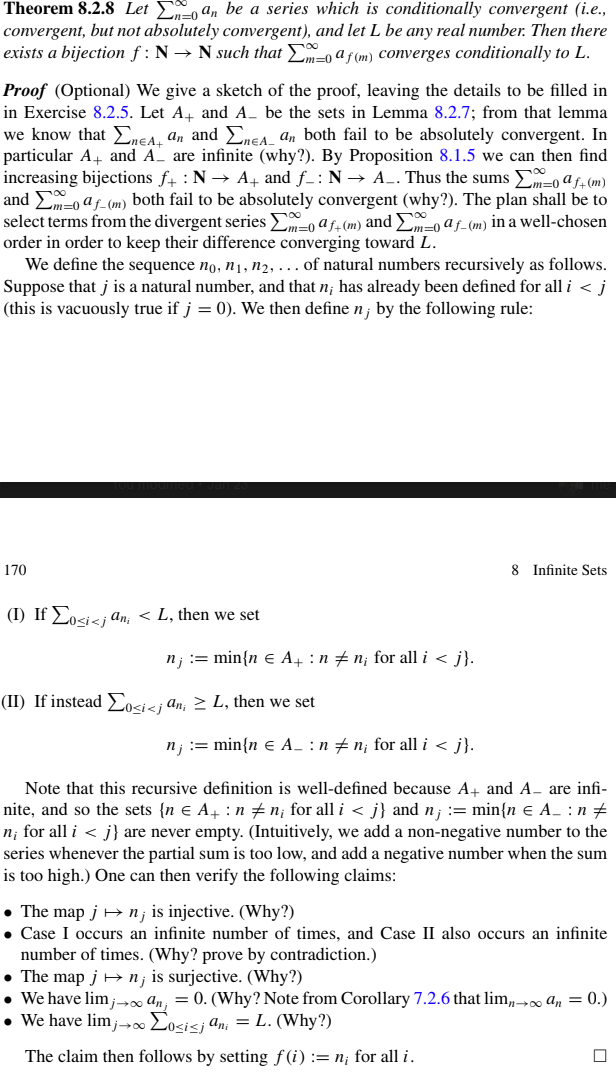
The companion translates that to Lean as this exercise and again asks to complete it by removing the sorries.
Here is how I approached this:
-
Rushed first attempt - I work on these exercises after my daughter goes to bed 9pm to 11-12pm, so during the workweek I am often a bit more tired and less motivated. I figured this problem was hard, so I didn’t bother reading the book scaffold and just asked Claude to grind it out (I had it sitting idle). After a day or so (no idea how much clock time it was), it produced a solution with zero intervention, which I checked in.
-
Correction - During the weekend, I came back to this as my goal is not to just get the lean solutions but actually understand the content. I read the book carefully and came up with a sketch of the proof for 9 sorries out of 10. The idea was something like (sadly I lost the log):
- 1 and 2 - by previous exercise both a_plus and a_minus are not abs convergent. So they have to be infinite.
- 3 and 4 - if a_plus or a_minus is finite, the tail of one of them matches a, but they are not convergent while a is, which is a contradiction.
- 5 - this is obvious by construction of n’, we never pick the same element twice.
- 6 and 7 - if the partial sums at some finite point stop crossing over L, that means the tail matches the tail of a_plus or a_minus. But those diverge, while there is a constant gap to L, a contradiction.
- 8 - direct consequence of 3 and 4. Since we pick infinitely many times from a_minus and a_plus by construction we have to pick all of them as the construction doesn’t skip.
- 9 - We have shown n’ is a bijection and we know
aas series converges, so the sequence must go to zero. - 10 - I have no idea actually.
Notably, this is not up to the standard of a modern mathematical proof. Nonetheless, it is a quick dump of my intuition, and now I have Claude and Lean to work through the details.
-
Collaboration - I read the Lean proof and told Claude to align it with my human idea above where it diverged. For parts that are pure Lean technicalities, I trust Claude — though I do look for something odd, since I heard Claude might inject tricky workarounds when fully stuck and left unattended for long. No such injections seen — no unfamiliar tactics, plausible theorems from mathlib. I didn’t dwell on minute tactic style points (theorem is too long to worry about ‘simp’ vs ‘omega’ etc). Claude restructures the proof somewhat.
-
Learning - Part 10 of the proof, I am stuck. I ask Claude to explain what is happening in words, convince myself on paper conceptually, then read the proof and agree it makes sense. This is tricky indeed. I ask to refactor a bit and add better comments matching my understanding, which I relay back to Claude as another intuition sketch.
-
Cleanup - I ask Claude to clean up the whole thing and commit. The result is 300+ lines of lean. I guess to both the uninitiated in Lean and the Lean expert, it looks like slop (for different reasons). But through this process, to me it is a formal proof that I roughly follow and can stand by.
Followup problem 8.2.6 - divergence after rearrangement
Once I understood 8.2.5, I was in a good position to solve 8.2.6 (which previously I couldn’t because I didn’t grasp the solution to 8.2.5).
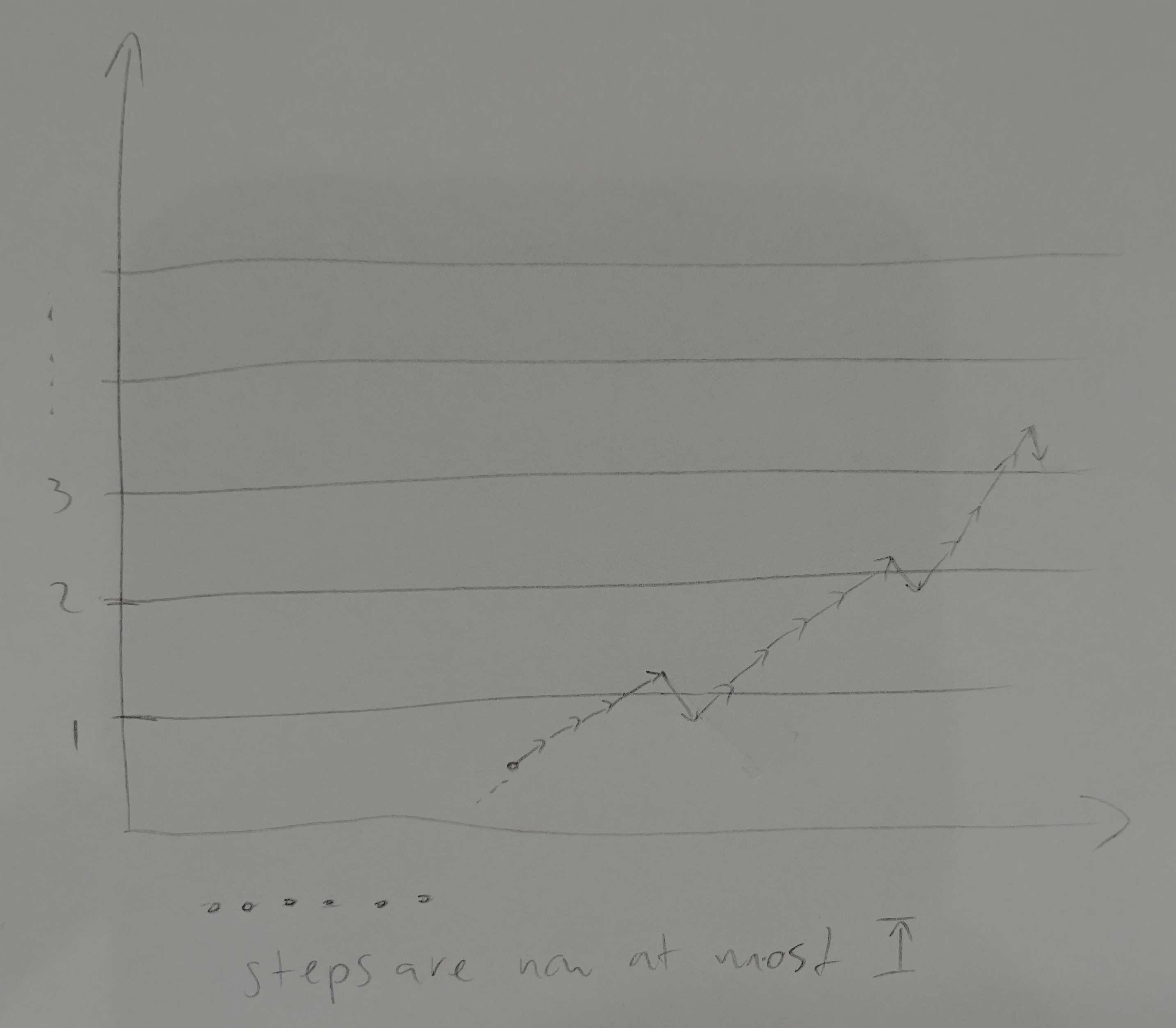
- The human idea - I came up with the following construction: take positive elements until the partial sum exceeds 1, then take one negative element, then take positive elements until the sum exceeds 2, and one more negative. Repeat to infinity.
This is the picture I had in my mind:
- Claude writes Lean - I gave that idea to Claude to grind. It too took some time (around 30min to an hour). I was observing its iteration. It is quite far from one-shotting — the construction is messy to work with — but it generally has the right idea in each iteration and hill climbs well.
- Intervention - As luck would have it, I spotted Claude stuck on a fundamentally missing piece from my original idea: how do you prove the single negative dip doesn’t pull back too far? We need to break each bound N without oscillating so much that the sum fails to diverge to +inf. I came up with using the lim a_f_i -> 0 knowledge from the previous problem. Not sure how productive it is to watch Claude’s inner monologue to spot these intervention opportunities, or how much longer I’ll have something to add as AI gets stronger. An area I wish AI improves in is knowing me better — when to stop and ask vs. when to keep going, especially when I am not even at the screen.
- Cleanup and generalization to -inf. I ask for refactoring with the -inf case in mind. Claude finishes that and we are done with the chapter, all in one 2-3 hour session. Another 300 line proof. When I was writing these by hand, a 300 line proof would take me at least 10 times longer.
Summary
I am surprisingly happy with this workflow and plan to keep charging ahead until I complete the Real Analysis exercises (likely another month or so). If I used Claude less I likely would have learned more about Lean and mathlib, but at the expense of 10x of my time, it doesn’t feel like the right tradeoff right now. I am happy that I can still engage the material on an intuition level. After the iteration we did, I feel the resulting lean proof is our proof not just Claude’s output. Admittedly I did much less work, but feel more like a collaborator than say a principal researcher whose name is on the paper because he provided the money (I did pay for the Claude $100/month subscription.)
As Terence Tao says in his interview:
There’s a big crowd of people who really, really want AI success stories. And then there’s an equal and opposite crowd of people who want to dismiss all AI progress. And what we have is a very complicated and nuanced story in between.
Practically, when using AI for writing Lean the two extremes are represented by:
- calling everything proofslop - “AI generated Lean is unreadable.” Not true. With some training and back-and-forth, AI produced proofs are not too far from human ones. Formalization is inherently more verbose and noisier because one has to deal with all details, e.g. sum_s in S f(s) really might depend on the mapping from N to S. Asking for the details is aligned with the goals and values of math.
- amazing producer of one-shotted breakthroughs - this is far from the truth. Current AI tools still need a lot of steering, and formal proofs remain harder than informal ones.
I believe I am finding a nice middle ground through my usage of Claude and Lean.
When I was in grad school I had a repeated feeling of being unable to see the forest from the trees. I was grinding through definitions and proofs with no intuition in sight, until I left academia altogether. In the new human / LLM / Lean collaborative math world, I feel I can stay more fully in the intuitive level, converse on that level with the LLM, which can then translate it to the formal Lean level (paying the high time cost of that conversion instead of using my human time) and bring back any missing insight to me. Finally, I know enough of Lean to spot check the formal level, but I’m not required to fully (especially outside definitions).
I can dream up math ideas, while Claude can ground them in Lean and come back to me with the logical reality. I don’t see this as a bad development.
Appendix: Riemann’s original proof
I thought it would be curious to see how Riemann actually proved it — original text (PDF) (used Claude for translation)
The insight into the path to be taken in solving this problem came to him from the recognition that infinite series fall into two essentially different classes, depending on whether they remain convergent or not when all terms are made positive. In the former, the terms may be arbitrarily rearranged; the value of the latter, by contrast, depends on the ordering of the terms. Indeed, if in a series of the second class one denotes the positive terms in succession by a₁, a₂, a₃, …, and the negative ones by −b₁, −b₂, −b₃, …, it is clear that both Σa and Σb must be infinite; for if both were finite, the series would still converge after making all signs equal; but if one were infinite, the series would diverge. Now it is evident that the series can, by a suitable arrangement of its terms, be made to equal any arbitrarily given value C. For if one takes alternately positive terms of the series until their sum exceeds C, and then negative terms until their sum falls below C, the deviation from C will never be greater than the value of the term preceding the last change of sign. Since now both the quantities a and the quantities b ultimately become infinitely small as the index grows, the deviations from C will also, if one goes far enough in the series, become arbitrarily small — that is, the series will converge to C. Only to series of the first class are the laws of finite sums applicable; only they can truly be regarded as representing the totality of their terms — series of the second class cannot; a circumstance that was overlooked by the mathematicians of the previous century, mainly, it seems, because the series that proceed in ascending powers of a variable quantity belong, generally speaking (that is, with the exception of particular values of that quantity), to the first class.
Curiously, Riemann’s proof reads more like my handwavy intuition sketches than a modern textbook proof — of course, it was 150 years ago. We’ve since adopted much stricter standards of rigor, and rightly so, but I feel something got lost in the process. With this new human + AI + Lean workflow, I find myself writing proofs at Riemann’s level of intuition again, while Claude and Lean handle the formal details. It feels like coming full circle.
Appendix: On AI-assisted writing
As an experiment I am leaving the initial pre-AI edits draft. I empathise with readers who are tired of plausible-looking but low-signal AI-generated articles. At the same time, I benefit from Claude’s efficiency in fleshing out my outlines. The raw draft should make clear this is not a one-shot post. Feedback welcome, we are all trying to figure out how this brave new world should work!